Solutions overview
 Account take over (ATO)
 Digital Impersonation
 Credit card data theft
 Man in the Middle (MitM)
 Credential stuffing
 SEO poisoning
 For security teams
 For fraud/risk teams
 For digital business teams
 Library
 Blog
Blog Glossary
 Partner Up
 About
About News
News Events
 Careers
 Contacts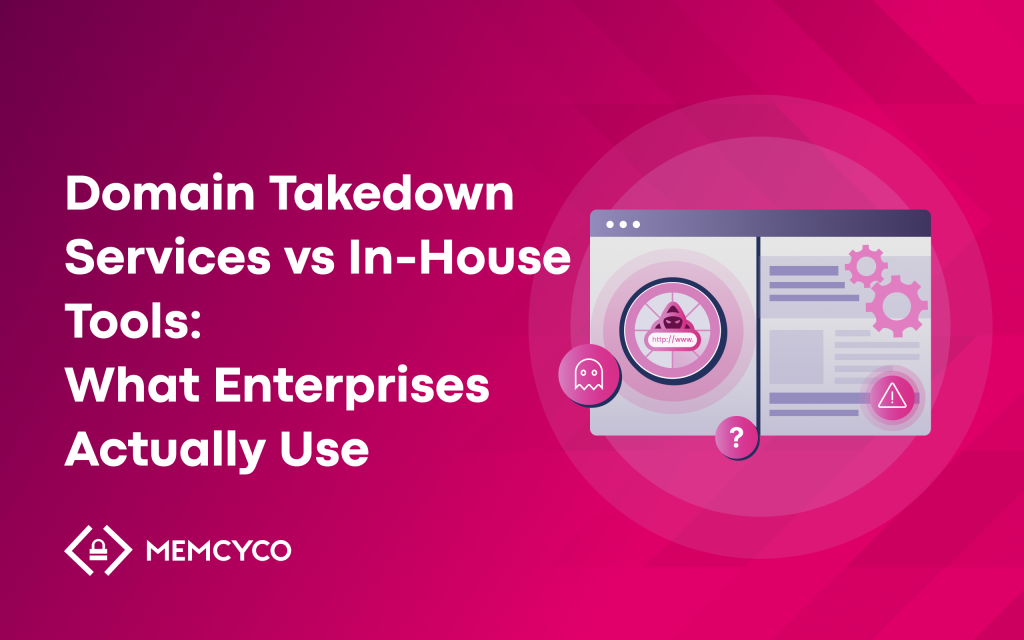
Domain takedown services are a familiar control for enterprises dealing with phishing, fake websites, and brand impersonation. When a spoofed domain appears, the instinctive response is to remove it as fast as possible. Security teams generally face a clear decision: handle takedowns internally using tools and SOC workflows, or rely on managed domain takedown services.
What is less clearly understood is that this decision is not really about preference or maturity. It is about timing, operational load, and what happens during the remediation window before a takedown is completed. This distinction matters because most damage from fake website attacks occurs before removal, regardless of who executes the takedown.
This guide examines how enterprises actually make that decision and why many conclude that takedown alone cannot be their primary line of defense.
The Structural Reality of the Remediation Window
The fundamental challenge of any phishing or impersonation takedown is that the attacker moves first. By the time a lookalike domain is detected, the infrastructure is already live.
From that moment, the enterprise enters the remediation window. This is the period of malicious uptime during which a fraudulent site remains accessible, harvesting credentials or facilitating fraud. The industry often measures this using Mean Time to Takedown, or MTTT.
Enterprises invest in domain takedown services or internal tooling to reduce this window. But compressing it is inherently difficult because takedown is an administrative process, not a technical kill switch. Whether handled in-house or outsourced, removal depends on third parties such as registrars and hosting providers acting on abuse reports.
No amount of staffing or tooling fully removes that dependency. The remediation window always exists.
Why Velocity Breaks Traditional Takedown Models
Modern impersonation campaigns are designed around speed and scale. Attackers rarely rely on a single domain. Instead, they launch multiple lookalike domains across registrars and jurisdictions in rapid succession.
This creates a velocity problem for defenders. When enterprises rely on manual domain abuse reporting, they often find themselves responding to individual sites while the broader campaign continues. Even when one phishing site takedown succeeds, others may already be active elsewhere.
At scale, takedown becomes a race the defender did not choose and does not control.
In-House Tools and SOC-Led Takedown Workflows
Many enterprises begin by building internal takedown workflows. This typically involves a mix of monitoring tools, domain abuse reporting, and manual coordination by SOC or fraud teams.
Why Do Enterprises Choose In-House Execution?
Organizations choose in-house execution when they want tight control over prioritization and visibility. Internal teams can correlate suspicious domains with internal telemetry, helping them understand who may have been exposed and how the threat intersects with other signals.
For low-volume or highly targeted attacks, this approach can be effective.
Where Do Internal Takedown Models Break Down?
The breakdown occurs during execution. In the era of Whois privacy redaction, identifying registrar contacts is increasingly complex. Abuse reporting processes vary widely, and response timelines are inconsistent.
Managing multiple manual takedown requests introduces significant SOC overhead. Highly skilled analysts spend time navigating administrative processes rather than investigating threats. As impersonation volume grows, MTTT stretches from hours into days, and analyst fatigue becomes a real concern.
Internal execution does not fail because teams lack skill. It fails because the model does not scale cleanly.
Managed Domain Takedown Services
Managed domain takedown services exist to reduce this burden. These providers monitor for impersonation activity, handle abuse reporting at scale, and leverage established registrar relationships to accelerate removal.
Why Do Enterprises Outsource Domain Takedown?
Managed services offer consistency and scale. Providers absorb the administrative load of takedown, allowing internal teams to focus on higher-value security work. In many cases, managed providers can achieve faster registrar-level mitigation than internal teams, especially across multiple geographies.
For high-volume or commodity phishing campaigns, this approach is often more efficient.
Where Do Managed Services Still Fall Short?
Despite these advantages, managed domain takedown services remain reactive by design. They reduce malicious uptime, but they do not eliminate it.
Even the most effective provider cannot guarantee instant action across jurisdictions. Successful credential harvesting often occurs early in a campaign. If removal takes several hours, the majority of damage may already have occurred.
This limitation is structural, not operational.
What Do Enterprises Actually Use for Domain Takedown?
In practice, mature organizations rarely choose one model exclusively. They combine in-house visibility with managed execution to reduce malicious uptime as much as possible.
Yet even this hybrid approach leaves a fundamental question unanswered.
What protects users while the takedown is still in progress?
When Do Enterprises Reassess Their Domain Takedown Strategy?
Enterprises rarely conclude that takedown has failed outright. More often, they reassess because operational signals begin to accumulate.
One common signal is MTTT trending upward despite stable tooling and staffing. As impersonation volume increases, even well-structured teams find that remediation windows stretch under load, particularly during coordinated campaigns.
Another signal is repeated user exposure during active incidents. Security teams may see phishing site takedown requests progressing as expected, yet still receive reports of customers encountering spoofed domains hours later through search results, ads, or shared links.
SOC leaders also point to capacity strain. When analysts spend a growing share of their time managing manual domain abuse reporting and tracking administrative responses, it becomes clear that takedown execution is consuming resources without reducing early-stage risk.
Finally, enterprises notice when takedown success increasingly depends on escalation rather than process. Reliance on special handling or registrar relationships is a sign that the model is operating at its limit.
These signals do not suggest abandoning takedown. They indicate that remediation alone is no longer sufficient as the primary line of defense.
How Do Enterprises Reduce Risk During the Remediation Window?
As impersonation tactics accelerate, enterprises are rethinking where protection must engage. The focus is shifting from who executes the takedown to what happens before removal completes.
Rather than relying solely on remediation, leading teams are adding controls that operate during live attacks. These controls focus on identifying impersonation activity as it affects users and intervening before credentials are stolen or sessions are compromised.
This reflects a broader evolution in how Digital Risk Protection Services are applied. The emphasis is moving from post-incident cleanup to exposure-aware protection.
Reducing Reliance on Takedown Alone
In this model, solutions like Memcyco are not positioned as replacements for domain takedown services. They extend them, but also reduce how much user protection depends on takedown timing.
Memcyco does this in two practical ways. First, it enables enterprises to initiate takedown processes automatically as soon as impersonation activity is identified, rather than waiting for manual validation or periodic review. This shortens the administrative path to removal and reduces delays caused by internal handoffs.
Second, Memcyco increases coverage by identifying malicious domains that have not yet appeared in threat databases. Instead of relying on intermittent scanning or known-bad lists, detection is triggered by real-world impersonation activity as it intersects with the genuine site. This allows enterprises to surface active threats earlier, including short-lived domains that traditional feeds often miss.
Crucially, Memcyco also protects users in real time during the remediation window itself, while identifying every single customer who visited the offending fake site. In short, Memcyco intervenes at the moment of deception, preventing credential exposure and account compromise while takedown is still in progress.
The result is not fewer takedowns, but faster initiation, broader coverage, and far less dependence on takedown speed to prevent harm. Protection shifts from after-the-fact cleanup to real-time attack interception and disruption.
Conclusion: Reframing the Decision
Domain takedown services and in-house tools are both essential components of modern brand protection programs. They remove malicious infrastructure and limit long-term abuse.
What they do not do is protect users during the remediation window.
Enterprises that understand this distinction move beyond debates about execution ownership. They design defenses that account for detection-to-takedown lag, malicious uptime, and real-world attack speed.
If takedown is your primary control, the real question is not who executes it, but what protects users before it completes.
Get a Memcyco product tour to discover Memcyco’s full platform capabilities, and why analysts are endorsing Memcyco’s preemptive, real-time approach to account takeover fraud protection.
Frequently Asked Questions
What affects Mean Time to Takedown (MTTT) for phishing domains?
Mean Time to Takedown depends on registrar responsiveness, hosting provider policies, jurisdiction, and whether takedown relies on manual abuse reporting or managed escalation. Third-party dependencies mean even mature security teams experience unavoidable delays.
How do domain takedown services compare to in-house SOC workflows for high-volume impersonation attacks?
In-house SOC workflows offer control and visibility, while domain takedown services provide scale and administrative efficiency. At high attack volumes, enterprises typically combine both approaches to reduce malicious uptime and operational strain.
Why do enterprises struggle with malicious uptime during the remediation window?
Enterprises struggle because domain takedown is an administrative process, not an instant technical action. While abuse reports are processed, impersonation sites remain accessible, allowing attackers to continue exposing users during the remediation window.
When do enterprises add managed domain takedown services to internal tools?
Enterprises usually add managed domain takedown services when impersonation volume increases, SOC overhead rises, or Mean Time to Takedown trends upward despite stable tooling and staffing levels.
What protects users from fake websites before takedowns are completed?
Enterprises reduce risk by deploying controls that operate during live attacks, identifying impersonation attempts as users encounter them and intervening before credentials are entered, complementing domain takedown rather than replacing it.

Head of Content Marketing